My Website

My Website
Click Above to Visit My Website Where I Share My Life in Manhattan, Tokyo, and Exploring the World

Friday, June 10, 2016

It’s June, So It’s Iris Time in Tokyo

June 9, 2016

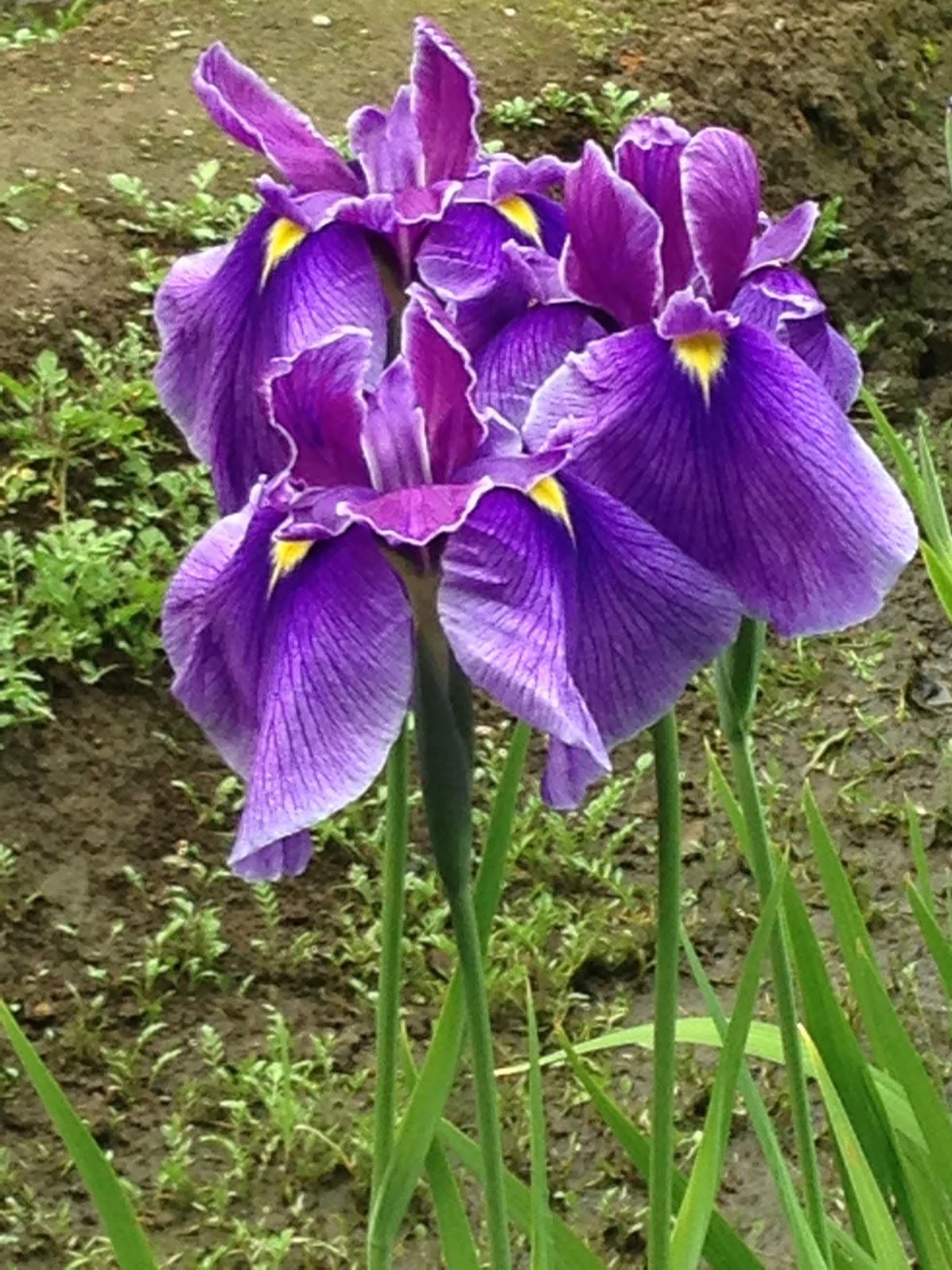
June is the month for Iris in Japan. According to all the sites, these beautiful flowers only last about a month. Though not nearly as spectacular as Cherry Blossoms and not nearly as abundant, I love Iris and wanted to see a few before they disappear.

Monday we headed off to the Koishikawa Korakuen garden, and got out at the subway stop Korakuen, crossed the street, and followed along the wall of the garden for a good ten minutes until we came to the now familiar entrance.

The Professor and I concurred that these Japanese gardens have it figured out. We have been to this particular garden multiple times: in the fall for the colors, in the spring for the plum blossoms followed by the cherry blossoms a month later, then again in May for the wisteria, and now in June for the Iris. Can you say: ka-ching? Each time we go, it’s another entrance fee. Though the fee is only around $3, it adds up when you go five times and bring a friend. It’s a good racket because otherwise, we’d only visit once and call it good.

The garden is not that large, but the area where the irises are—though not that large—did not disappoint. 


Monday was a beautiful sunny day, great for Iris viewing. Tuesday it rained, so we stayed home. But Wednesday promised to be rain free so we headed out to the Meiji Jingu Inner Garden within the Meiji Shrine area to see more irises.

Again, we have been to the Meiji Shrine area multiple times now and each time we have passed the entrance to this little park within a park—the Inner Garden. There are actually two entrances to this park—one right past the main Tori gate and another after the second Tori gate. Without the Iris posters to point this out, we had never even noticed the first entrance.

Thanks to the posters, this time we saw it, paid the 500 yen entrance fee and walked inside.

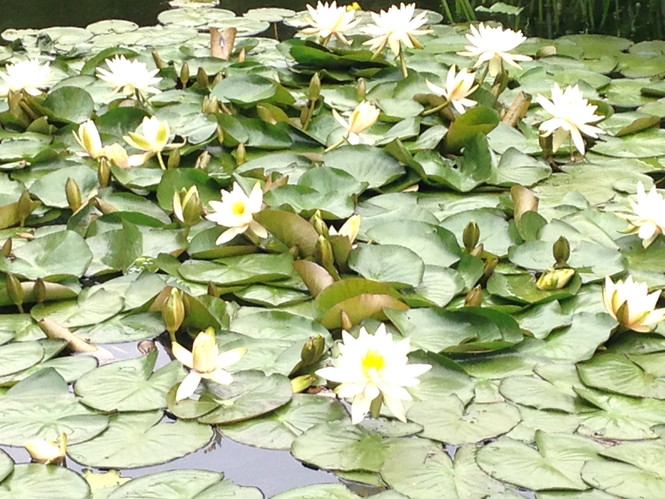
First stop was a beautiful pond filled with huge carp and lots of beautiful lily pads, some in bloom.

 
At the top of the hill and overlooking the pond is a teahouse that we walked up to see. This is apparently a favorite place for the Empress to hang out, according to the brochure.  There was definitely a serene view from here—though sadly I don’t have a photo.

We followed the crowd along the path to the iris area. It was pretty. Not large and overly impressive, but still a nice pretty dose of color to brighten the day and our mood.


We then followed the crowd along the path some more, past the iris area, to the well where the water springs forth and is used to water the iris.


It had its own guard to make sure everyone formed a line and didn’t push as everyone walked up to the well. Not wanting to be the odd person out, we followed suite and stuck our hands in, too. The water was so clear and cold.

I told the Professor I was tempted to take a sip, but decided against it. No need to bring home any unwanted parasites—plus I’m horrible with pets. So much responsibility. I fought the feeling.

We then followed the crowd back out into the cacophony of Harajuku.

Friday, May 27, 2016

Mt. Fuji Is Not Just a Mountain in Tokyo


Wednesday, May 25, 2016

On a good day, Mt. Fuji summons you for miles as you drive closer to the lakes and the small towns scattered along its base. It is a beacon to the traveler.

It can appear against a bright blue sky or a pale gray one when it’s windy and overcast—which is pretty in its own way. It is a piece of artwork that provides an amazing backdrop.


It can hover in the background and keep watch over a beautiful old settlement of thatched roofs now known as SAIKO Iyashi no sato NENBA—or the Healing Village. Surrounded by verdant greenery you can commune with nature or buy a piece of blown glass or some handmade paper products while the mountain watches. It has been here since before the thatched roofs were ever built, and it plays an integral part in the healing.


The clouds can swirl around its peak and threaten to hide it when you stop for a lunch of thick noodles, and veggies in a thick broth. It is a reminder of how quickly things can change.


But if you’re lucky, you get to see the mountain the entire time you are there, and will feel blessed because of it. It is a reminder that you are in Tokyo, and in the presence of grandeur. 


And Mt. Fuji reminds you that it is not just a mountain, but a shy flirt that teases.  But sometimes gives you what you want.

Thursday, May 26, 2016

Sanja Matsuri—One of the Wildest and Largest Shinto Celebrations in Tokyo

Saturday, May 14, 2016

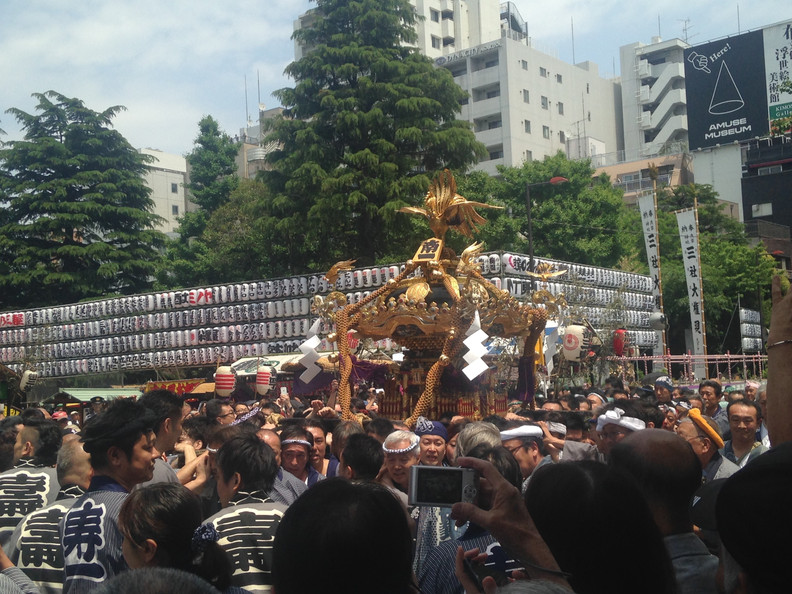
Sanja Matsuri is centered around the third Sunday of every May and is held in honor of the three men who established and founded Sensō-ji. It is one of the largest and supposedly wildest of the Shinto celebrations in Tokyo.

The festival's three-day celebration begins on Friday with a large parade. This famous 19-block grand procession goes down Yanagi Street to Asakusa Shrine and is known for its participants—geisha, musicians, performers and dancers—all wearing traditional Japanese attire. In the evening, six mikoshi (smaller local shrines) from the most central neighborhoods are sent parading through the streets on the shoulders of several dozen people.

On the following day, Saturday, approximately 100 mikoshi from the 44 Asakusa districts are carried through Nakamise-dōri to Asakusa Shrine where Shinto priests bless and purify them for the coming year. When the ceremony is completed, they are then carried back and paraded through their respective neighborhoods.

The most important event occurs on Sunday. This is the procession of the three huge, elaborate Asakusa Shrine-owned mikoshi early Sunday morning to the shrine. They represent the three founders of Sensoji. The three shrines then head out to bestow blessing to all 44 districts of downtown and residential Asakusa. When evening falls, the three shrines are brought back to Asakusa Shrine in another grand procession that lasts late into the night. 

Due to time constraints we had to choose one day to visit this festival and chose Saturday so that we could see the excitement of the various groups from each neighborhood as they carried in their small shrines for the blessings by the priest. Teams compete for the most spirit.


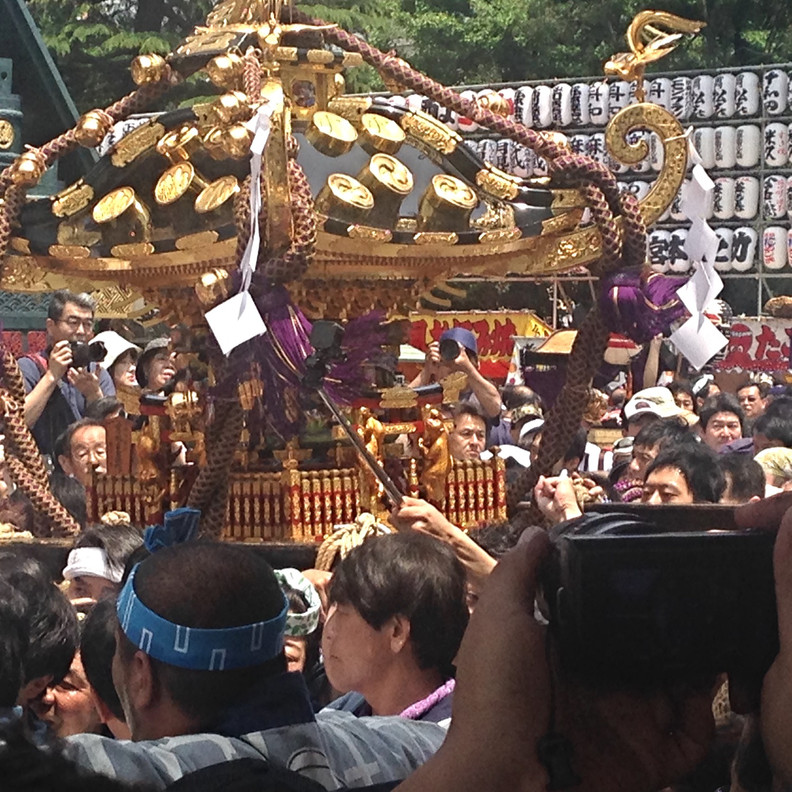
The shrines may not have been all that huge, but the spirit of those carrying the shrines and representing their neighborhoods was enormous. And carrying the shrines is a feat of endurance as most of them are pretty heavy looking and it was really hot.


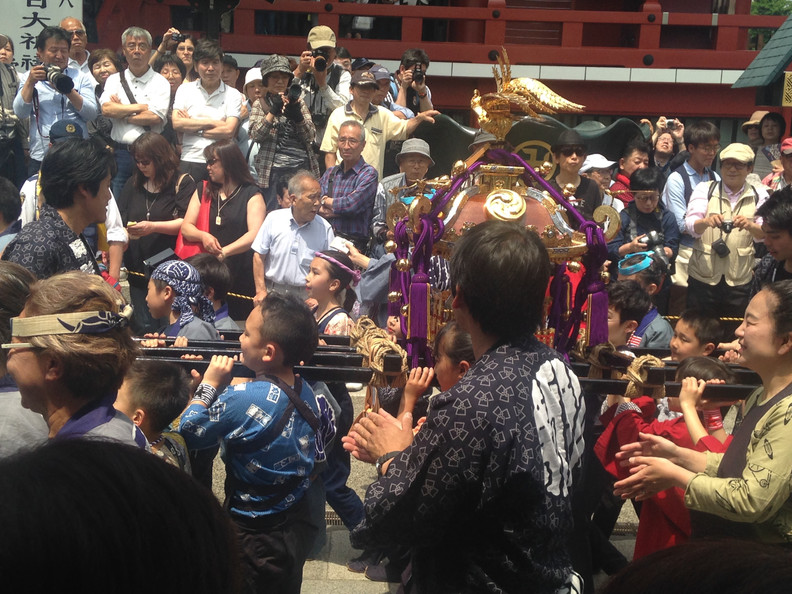
Some groups consisted of children, while others were made up of hot, sweaty adults. But each group carried the shrine into the shrine area while shaking it up and down. Once they arrived in front of the priests they would lift the shrine up and shake it . And all the while chanting.


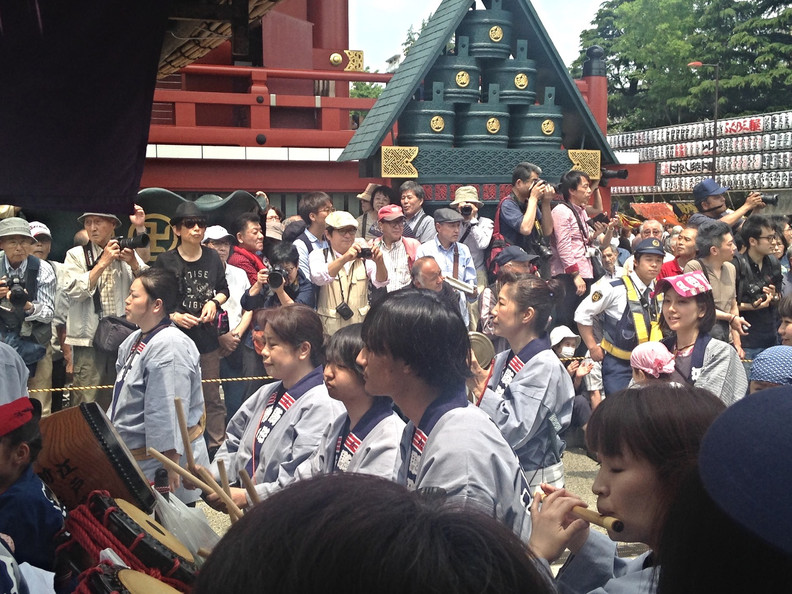
Some of the shrines consisted of musicians playing their instruments and were not carried, but pushed along on wheeled booths as they walked along behind playing music.


The area was filled with adrenaline—and confusion reigned too, as the cops tried to make some order of the chaos. Shrine participants paraded past, while clueless tourists—all trying to get the perfect  picture—wandered everywhere. It was all very exciting.


Then after an hour or more of watching the entrance of the shrines, we took off in search of some of that great festival food.


Friday, May 20, 2016

Fun With Animal Crackers in Japan


One of the things I love about Japan is the unexpected fun you find in the oddest places.

These are animal cookies purchased from the Donki store (discount department store of weird items in Japan)for a whopping 78yen (not even a $1). I love the random and exotic animals listed. They are so specific naming a polar bear (not just a bear), a panda, a macaw (not a bird), a tapir (a what?), a peafowl (not even sure what that is), and a cow. I would have expected it to be a Jersey or whatever a Japanese cow type is.

Then they went on to include rats (yum?) and furseals (is that before or after they club them)?


Notice how the hawk doesn’t look like the macaw? Though the lynx looks a tad like the leopard… I am still impressed!


The only one I have to say was a dud was the squirrel. I’m having a hard time seeing it. 


Oh well. Overall, a fine job and loads of fun and they spelled everything correctly. And they were tasty, too!


Wednesday, May 11, 2016

In Search of the Elusive Wisteria in Tokyo

Picture of poster. What it's supposed to look like.
Tuesday, May 3, 2016

It’s that time of year in Japan when the wisteria is in bloom. Though almost as popular as its famous floral cousin, the Cherry Blossoms, wisteria is not nearly as easy to find in Tokyo. Many parks have one or two wisteria plants but there are only a couple of places we discovered that promised an impressive amount of the beautiful flower.

Kameido Tenjin Shrine  was the closest and listed as the best place in Tokyo to see the flower— and it also was celebrating with a Wisteria Festival from the middle of April to the middle of May.

We got off at Kameido Station and followed Google Maps through some small side streets—finding nice little surprises along the way. I especially loved this main shop district street with all the banners and fish flags celebrating the impending Boys Day.


We walked past this area and followed the Wisteria Festival flags down the main streets until we found the shrine. The park area consisted of a large pond, wisteria trellises, a shrine, and an arched bridge. Because the festival was going on, multiple food vendors were set up around the pond area. But sadly the wisteria blossoms were mostly dried-out husks. Word to the wise: go in April for best results. It was still pretty to see, however.


Thursday, May 5, 2016

After being disappointed by our trip to the Tokyo-based wisteria, we decided we couldn’t wait any longer to head out to the big daddy of them all in wisteria displays: Ashikaga Flower Park. To get to this park, it involves many forms of transportation and takes anywhere from 2-3 hours to get there from where we are. It was a commitment.

I do not suggest this trip for the weak of heart or for those who are just looking for something to do. As, I mentioned before: only the committed and true wisteria lovers should attempt.

First off, when trying to figure out the train/subways to get there we got answers that ranged the gamut from $19- 50 ow and multiple choices that changed EVERY single time we looked it up. It was exhausting before we even left our apartment.

We picked one of the choices that took us to Kitasenju Station to grab a train—which, it turned out,  was not listed on any of the signs. We finally asked a train station worker who directed us ‘to follow the blue line and go down two floors.’ We Finally found it, bought a separate ticket for the Ryomo semi express train at approximately $16 to go the two stops. But first we had to wait 40 minutes for the train to come. (On the way back: we just took the regular subway trains, bypassed this step, and saved ourselves time,  money and heartache.)

After boarding the Ryomo, followed by two other train lines, we exited at Tomita Station. However, from Tomita Station, it is another 15-minute walk or so along the highway (directions are available to print out from the Ashikaga Flower Park website—but you can also just follow the huge crowd of people). Perhaps if you arrived very early and had no crowd to follow, you may wish you had the directions, but we didn’t arrive until almost 4pm(!) so there were plenty of people to follow.


The park is home to quite a few huge wisteria trellises—two of them over 150-years old! Not only do they have the usual purple wisteria (best in Late April – Early May), but they also have a pale pink one (best in Mid – Late April), white ones (best in Early May), and a yellow Laburnum which grows on an arched trellis and looks very wisteria-like (best in Early – Mid May).  And right on schedule the pale pink wisteria blossoms were just like the ones at Kameido Tenjin Shrine—dried out. Though a little disappointed in these, the rest were so beautiful it didn’t matter. And, the huge canopy was still green and provided the atmosphere—though it must have been even more beautiful a few days before.


The map lists the wisterias as: a Large Wisteria Trellis (1000 m in size!), a rare Double Flowered Wisteria, a Large and Long Wisteria Trellis, a Tunnel of White Wisteria, a Tunnel of Golden Chain, a Screen of Purple Wisteria, White Wisteria Falls, Light Pink Trellis, Wisteria Dome, and a Purple Wisteria Trellis. These do not include the little random wisteria bushes scattered throughout, or the Azaleas, roses, and other flowers scattered throughout. There were even some that looked an awful lot like the California Poppies of home.


There are also water features, and areas to sit and observe, as well as eating and shopping areas scattered throughout all the floral. It is amazing.


During the wisteria season, the park also stays open late and they turn the lights on at 6pm to give the plants a whole different look. The lights really make the colors pop and everything looks different in the twilight.


This Ashikaga Flower Park is open all year except for the third Wednesday and Thursday of February, and December 31. The flowers change during the year and there is a beautiful garden of Illuminations in the winter. Entrance fees vary depending on the quality and quantity of blooms. Check schedules on their website for late night hours because as I said it took us hours to get there. You want to give yourself at least two hours there.

The park was rated one of the Top10 International Dream Destinations in 2014 by CNN. And deservedly so. It’s worth the hardship to get there.


Sunday, May 1, 2016

2016 Nakizumo Event in Tokyo. Almost Too Much Cuteness.


Friday, April 29, 2016

When we found out we were coming to Japan for nine months, we started looking for things to see and do during our stay. One of the first things on my list was the Nakizumo event. It occurs every Spring at the Sensoji Temple in Asakusa. It involves sumo wrestlers and babies. What’s not to like?

Parents bring their babies who were born in the previous year, get them blessed by the Shinto priests, then two at a time hand over their babies to two junior-level sumo wrestlers up on a stage. The object is to make the babies cry. It’s based on a Japanese belief that crying babies grow fastest.


The sumos do nothing but cradle the babies (it’s so cute) and hold them in the air, and the referee yells ‘naki, naki, naki’ (which means ‘cry’). The first baby to cry, or the one who cries the loudest is the winner. If the babies don’t cry, other guys sitting on the sidelines don a devil mask and try to assist.


It is good luck for babies to participate and the event is held yearly. Usually the event is held on the 4th Sunday of April but we went down there only to find out it was not happening that day. I was so sad. It took me lots of searching to finally find the correct info which was that it was scheduled for Friday, April 29, at 12:30pm. So thanks to the FaceBook website for Cultural Excursions in Japan who provided this link from the Taito Ward site (the area where Asakusa is located) with the correct date and time: http://www.city.taito.lg.jp/index/event/kanko/naki-zumou.html

The event is located behind the shrine.

Babies and sumo wrestlers are definitely on my list of favorite things. It was definitely worth the visit and I am so glad we finally got to see it!


Thursday, April 7, 2016

Sharp-Toothed Demon Stopped in Japan

Sunday, Apr 3, 2016


The Shinto Kanamara Matsuri—aka the Festival of the Steel Phallus—is held each spring at the Kanayama Shrine in Kawasaki, Japan, on the first Sunday of April.

The shrine is the destination at which to pray against sexual diseases, or to pray for fertility (depending on which you want, I guess).  The festival is based on a 17th-century story of a nasty sharp-toothed demon who fell in love with a woman who spurned him. The demon got mad and developed a bad habit of castrating the woman’s boyfriends with his teeth. Frustrated, she had a large steel phallus made by a local blacksmith which broke the demon’s teeth, stopping him, and saving her from a lifetime of endless cartons of Ben and Jerry’s.

The parade and current festival began in 1977 and has grown over the years to include a couple of other penises, food booth vendors on the shrine grounds, penis-themed items to purchase, and lots of photo ops.


The shrine is located just a few blocks from the train station with lots of local vendors selling homemade rice crackers, candies, and gift items leading up to it. During the festival there is also an added grouping of local food vendors selling not only the typical festival food—like meats on sticks, fried noodles, baked potatoes, and cans of beer—but a lot of others I’d not seen before, such as fried wontons on sticks and fried tofu dishes. All were tasty or looked tasty.


A few blocks over is the park area where the tables selling penis items are set up and where the parade ends. All sales on these items go to various organizations—HIV research and other good things. The crowd here wasn’t too bad at first, but it got really crowded the closer to the parade it got and immediately after.


The parade—which is really just a procession of three penises and some people waving fans and flags for a couple of blocks—started at around noon and ended at the park. Once the parade ended, a lot of people made their way back to the shrine area and the food booth area got way too crowded.


We had arrived around 11am, ate food, then walked over to the park to see the parade. Afterwards, we walked back to the shrine area but it was so crazy by then, we left. 

I loved how everyone, including little kids were sucking on penis pops. In America everyone would be way too uptight.


Contact Form

Name

Email *

Message *