My Website

My Website
Click Above to Visit My Website Where I Share My Life in Manhattan, Tokyo, and Exploring the World
Showing posts with label JapanFestival. Show all posts

Monday, July 11, 2016

It Just Gets Better in the Dark at the Tanabata


Sunday, July 10, 2016

Yesterday was the final day of the three-day Shonan Hiratsuka Tanabata and since it’s the biggest in our region of Japan and in its 66th year, we decided to make the hour-and-a-half, approximately $14ow trip out to Hiratsuka to see it.

Being we weren’t really sure what we were going to see, we wanted to make sure it was either the biggest or the oldest or the best of whatever a Tanabata is.

I found this July 4, 2016 description written by Tiffany (so it must be true) on the TokyoCheapo website:
“Tanabata is a celebration of the meeting of two legendary star-crossed lovers, the cowherd Hikoboshi and weaver girl Orihime. It is usually celebrated on July 7th, but different areas or regions have different dates to celebrate it. Generally, festivities, which entail writing wishes on strips of paper and tying them to trees (or bamboo strips), take place between July and August.”

Because there was a limited amount of info provided in English, and from the pictures on the website, we gleaned it was like a street festival for locals. There are music groups (though we didn’t see any), and those big, weird-looking creatures with a person inside to pose for pictures with, sometimes parades (which we also didn’t see), and food booths. This Tanabata according to their website also had dinosaurs, for some reason, which we also didn’t see.

We based our trip on a photo of brightly lit-up things that looked like balloons or floats or something equally big and festive. Nothing like spending your energy, time, and money going out to see something that you weren’t really clear on.

What we DID see once we got there was lots of men and women wearing the traditional kimonos, as well as little kids looking especially adorable.

​​

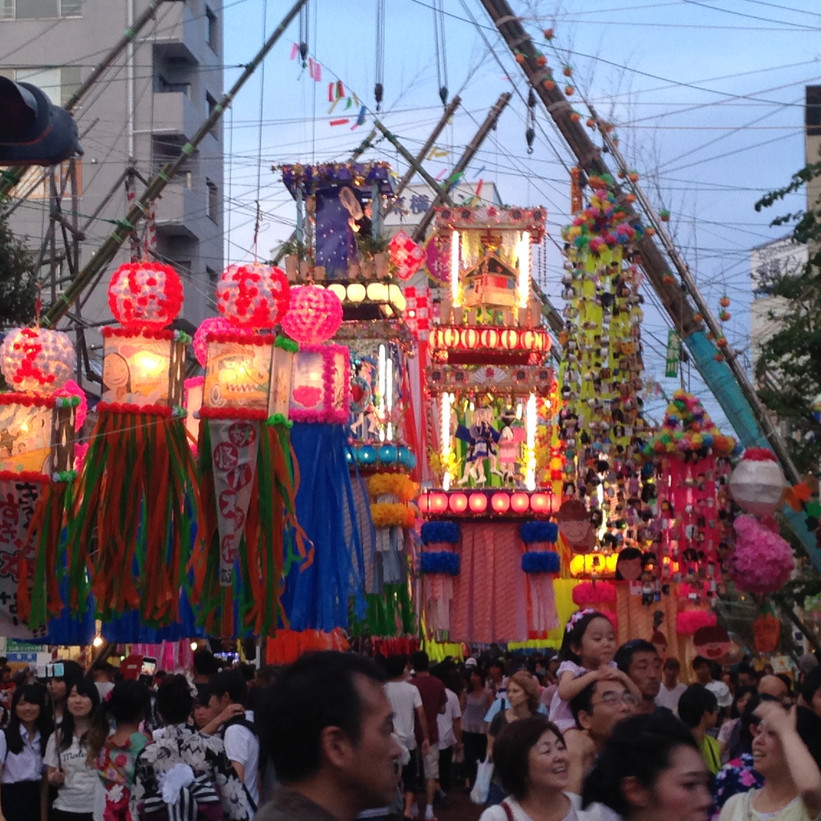
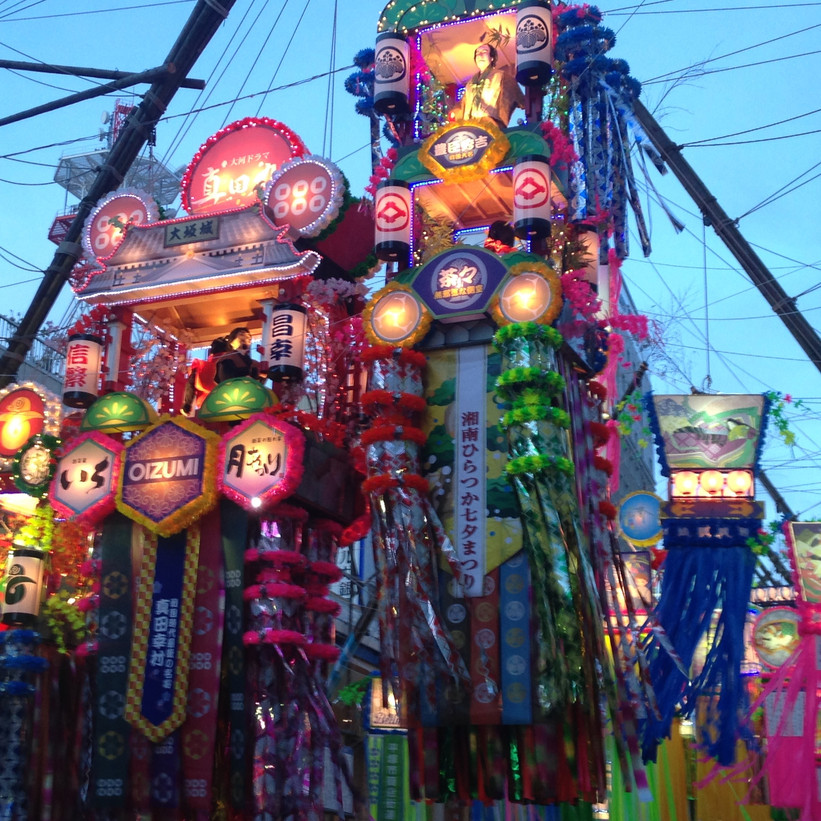
There were colorful streamers and paper decorations along and across the main streets all around the northern section from the train station. Just follow the crowd.


So pretty.


And it got even more beautiful in the evening. Seeing these at night made it all worthwhile.


​
Though this was our first—and I still am not quite sure what a Tanabata is exactly for—it WAS colorful and it was packed with people like Times Square in the summer.

But unlike Times Square, it was worth the time and expense to see this interesting slice of life in Japan.


​​
 

Thursday, April 7, 2016

Sharp-Toothed Demon Stopped in Japan

Sunday, Apr 3, 2016


​​

The Shinto Kanamara Matsuri—aka the Festival of the Steel Phallus—is held each spring at the Kanayama Shrine in Kawasaki, Japan, on the first Sunday of April.

The shrine is the destination at which to pray against sexual diseases, or to pray for fertility (depending on which you want, I guess).  The festival is based on a 17th-century story of a nasty sharp-toothed demon who fell in love with a woman who spurned him. The demon got mad and developed a bad habit of castrating the woman’s boyfriends with his teeth. Frustrated, she had a large steel phallus made by a local blacksmith which broke the demon’s teeth, stopping him, and saving her from a lifetime of endless cartons of Ben and Jerry’s.

The parade and current festival began in 1977 and has grown over the years to include a couple of other penises, food booth vendors on the shrine grounds, penis-themed items to purchase, and lots of photo ops.


​​

​​

​​

The shrine is located just a few blocks from the train station with lots of local vendors selling homemade rice crackers, candies, and gift items leading up to it. During the festival there is also an added grouping of local food vendors selling not only the typical festival food—like meats on sticks, fried noodles, baked potatoes, and cans of beer—but a lot of others I’d not seen before, such as fried wontons on sticks and fried tofu dishes. All were tasty or looked tasty.


​​

A few blocks over is the park area where the tables selling penis items are set up and where the parade ends. All sales on these items go to various organizations—HIV research and other good things. The crowd here wasn’t too bad at first, but it got really crowded the closer to the parade it got and immediately after.


​​

The parade—which is really just a procession of three penises and some people waving fans and flags for a couple of blocks—started at around noon and ended at the park. Once the parade ended, a lot of people made their way back to the shrine area and the food booth area got way too crowded.


​​

We had arrived around 11am, ate food, then walked over to the park to see the parade. Afterwards, we walked back to the shrine area but it was so crazy by then, we left. 

I loved how everyone, including little kids were sucking on penis pops. In America everyone would be way too uptight.


​​

Friday, December 4, 2015

Floats, Fireworks, and Food Vendors in Chichibu


Thursday, Dec 3
Despite our proclivity for procrastination, The Professor and I made it out to see one of the three biggest and most famous float festivals in Japan yesterday: the Chichibu Yomatsuri, Night Festival. The activities of the two-day long festival culminate on the second day with the pulling of six giant floats through the town and up to the City Hall Plaza to get blessed by priests. These ancient floats—each representing a neighborhood in the mountain city of Chichibu—are decorated with wooden carvings, brightly lit paper lanterns, can weigh up to 20 tons each, and are about 6 meters tall. During the festivities these massive floats are pulled up a slope by small squadrons of people dressed in traditional garb, and are perfect examples of ancient Japanese history in action—and the event was top of our Things-To-See list.

First, I’d like to share a quick note as to how we made it to this festival because it’s such an Only-in-Japan moment. We had waited until the day before to book our train tickets to this event—even though we knew that hundreds of thousands of Japanese attend. On Wednesday we went to the Ikebukuro station to purchase reserved tickets for the Red Arrow Limited Express train, but found that nothing was left for the return times after 7:30pm. Considering the best of the festival happens after 7pm and lasts until 10pm, we sadly determined we would have to miss this event. However, upon leaving the ticket office, I spied a tourist desk across the hall and decided to go over and ask them about the festival. The four people manning the tiny desk area of about 20 square-feet were very helpful. We mentioned to them how the trains were sold out, and one of the English-speaking girls offered to accompany us back across the hall to speak with the non-English-speaking train people regarding other options. She took us back to the ticket office, talked to the woman, and voila, a few minutes later we were told we could purchase express ticket seats leaving from a small town outside of Chichibu called Hannō. This option would require us to take a local train from Chichibu to Hannō, but we’d have seat reservations back into Tokyo from Hannō. We happily bought our tickets, then followed her back to the desk where she wrote out the train times and instructions. It was an amazing new height of customer service never to be seen in America.

And that is how we found ourselves the next day, Dec 3, in Chichibu. As we exited the train station and onto the street in front of it, we found ourselves immediately immersed in hoards of people and food stalls. Wandering around we heard Taiko drumming and followed the sounds to a nearby stage where we stood listening for a few minutes before deciding we could multitask and followed our noses to the food vendors. We then began our attempt to taste a bit of everything we could get our hands on, it seemed. Over the next six hours we shared dumplings, two types of noodle dishes, bowls of ramen, a grilled fish, chunks of grilled pork on a skewer, miso-flavored potatoes, a huge meat-filled bun, candied grapes, and copious amounts of beer and sweet wine.  We were killing time as we waited for the beginning of the float pulling.

During the day the floats sit on a street behind the train station and those who are to later participate in the parade use that time to self-medicate or build up their strength reserves, I believe. I saw a lot of happy red faces in the crowd of soon-to-be float-pullers during the hours leading up to the beginning of the parade. As the darkness started to settle, the groups of men and women grabbed the heavy ropes and began pulling the floats down the street and over to the main street, and on up a slight slope to the main plaza area near City Hall in response to the expectant screams and cheering from the massive crowds. Accompanying the floats were the sounds of Taiko drumming, and the calling out of a sing-song chant that sounds like it’s a ‘you-can-do-it’ mantra coming from those astride the top of the floats as well as from others in the crowds on the ground, and lots of fire works.

The beauty of this event—besides the spectacle of the many lights and the impressive size of the floats, the excitement of the crowd, and the seemingly endless sea of food options on little streets winding off in various directions—was the seemingly endless supply of fireworks. From about 7pm until 10pm, there were multiple fireworks going off in various groupings. It was not a nonstop three-hour show but there were more fireworks at this festival then I’ve ever seen at one sitting. It was beyond amazing. As far as I’m concerned, the fireworks made the whole trip worthwhile. And those fresh dumplings. And the noodle dishes and warm, sweet rice wine. And those potatoes were pretty darn great, too...


The only bad part of the evening was that the local train leaving Chichibu was late, getting us into Tokyo late—Japanese trains are rarely ever late—and it caused us to miss the final train to our neighborhood stop. Trains in Tokyo do not run past 12:30am (which is crazy as far as I am concerned). Missing our train meant we ended up walking the last mile or so home, which wasn’t really a bad thing since the night was crisp and clear, and we needed to work off a few thousand calories.

Saturday, November 28, 2015

Kanpai! And Money Laundering.


Saturday, Nov 28
Another beautiful sunny day in Tokyo lured us back out into the city. This time our destination was a shrine called Koami Jinja a few blocks away from the Kayabacho station. This shrine is believed to offer protection against evil spirits and brings good fortune.

According to an article I read on the website Trip101, the reason for this belief is because the shrine survived the bombings of WWII, as well as all the soldiers who came here before heading out to battle survived unscathed. Now people come here for many reasons such as when looking for jobs, buying lotto tickets, before exams, etc.


Despite the fact I’m unemployed and could use help in the job-finding department, the actual reason we made it our destination yesterday was because of their Doburoku Festival (a celebration of home-brewed sake). Another Festival, yes—and I will be reporting on lots of festivals because these Japanese like to party, and the price is right: free.

Visitors also come here to wash their coins in a small well. Once washed, these coins need to be carried in the wallet to bring the holder good luck and prosperity. Let me tell you, we washed some coins.


Besides free sake samples, there was also Shinto dancing and music performed.  The dancing took place in the shrine itself but it was hard to see from where we stood. I could see a person in a beautiful kimono of white with silver design, wearing a big floppy gold hood and wearing the smiling-Buddha-like mask one sees in pictures, moving slowly and precisely. Drumming and chanting accompanied the anonymous dancer. It seemed like something from a different time and I would have liked to see more.


After this dancing, three young musicians dressed in black kimonos and black hats came out onto the second floor balcony and began playing some music while a young woman dressed in a beautiful white and red kimono with a gold headpiece danced. It was interesting, too, but the music sounded a bit like when my little brother was first learning to play the clarinet. I can’t say I liked it a lot. I couldn’t tell what instruments were being played besides a flute. They played two songs. The first one was for the young woman to dance with a fan. The second song, sounding much like the first song, accompanied her as she danced with a branch of foliage.


After we had watched, washed and drank we headed off to the Shinjuku area in search of something alcoholic to drink.

And past the Hello Kitty street barriers, we had success.


Sunday, November 22, 2015

Otori-Jinja Shrine


Wednesday, Nov 18
Last night we took the subway to witness our first of many Japanese festivals. The Japanese seem to have festivals for just about everything and last night’s was called the Tori-no-Ichi festival. This festival is celebrated at many shrines throughout Tokyo and Japan, and we decided to go to the largest in our area: the Otori-Jinja Shrine—just an 8-minute walk from the Iriya stop on the Hibiya Subway Line 

The Tori-no-Ichi is a fair held on the days of the rooster in November. This fair is sometimes called…Otori-sama…[for] the patron deity of good fortune and successful business… [The] fair is set…with open-air stalls selling kumade rakes for 'raking in wealth and good fortune.' This good-luck rake is made of bamboo and is decorated with masks and …old gold coins (http://www.jnto.go.jp).

[The fair is] where one gives thanks for a safe year and prays for happiness in the next; not unlike an American Thanksgiving and [is] held…every November since the Edo era (the Christian era 1750-1760). While being the 
last big event of the year, it is also the first event in the course of new year’s preparations. It thus forms the bridge, 
both economic and psychological, between the old and new years, emphasizing the continuum of time in society from year to year (http://www.otorisama.or.jp).

I’ve provided detailed info above from two websites on what the fair is about, because based on my American-centric experience I had no idea of what was being celebrated or how.

We arrived about 4pm and noticed the lighted Japanese lanterns from the distance as we approached from down the street. They surrounded the shrine entrance providing a welcoming beacon and added to the festive feeling. A large crowd was already gathering at the shrine efficiently forming two lines--one going down each direction of the sidewalk. These opposing lines quickly came back together at the entrance of the shrine to enter as one. High up on a platform on either side of the entrance was a young man dressed in white, continually waving a wooden handle of white strips of paper back and forth. Passing these two men and entering the shrine one was hit with an explosion of color. Along both sides and branching out into the shrine area were lines of booths filled with brightly colored items that were either attached to bamboo handles or looked like overstuffed baskets of color. These were the ‘good fortune rakes’. They were of various styles and sizes and covered the tops of the tables on up the walls at least ten feet or so—and all added to the cornucopia of color. Some were just baskets with a smiling face attached to the inside and others were baskets jammed with multiple figurines, flowers, pieces of paper, and ribbons of reds, yellows, blues, silvers, golds and greens.

I had read somewhere that when people buy the rakes, multiple groups of people chant and clap and that this is what adds to the excitement of the festival; but I only heard chants and claps a few times and only saw a few people carrying the rakes around so there wasn’t much of this going on while we were there.

As we stood waiting to enter the shrine, we noticed some festival goers handing the rakes over to a group of people located outside the entrance. It looked like they bought the rakes, carried them around, and then recycled them back to this awaiting group who took them and unceremoniously dumped them into a bag with others. 


Still unsure of what was going on, we just followed the crowd in and enjoyed the explosion of color and activity around us. We moved off as we got to the back of the shrine where people rang the bells by yanking on long ropes hanging from the ceiling—and just exited out the back and into a huge street fair.


It was a street fair filling multiple streets and there were blocks and blocks of food vendors selling chocolate-dipped bananas, deep-fried things, strips of meats and whole fishes on sticks, various types of noodle dishes, baked potatoes, squid balls, booze, dumplings, tofu dishes, hamburgers, sausages, tiny candied apples, and even cotton candy.


We were in heaven. Now this I could understand!

Contact Form

Name

Email *

Message *